“The ceiling is the baldest part of the whole building…here I am free…where I can make it rich and handsome without coming in contact with any ugly necessity.” John La Farge, The Art Amateur, 1879.
Drawing the Eye Upward
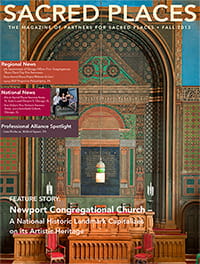
In keeping with his decision to draw the eye upward to the highest points of the church, the most elaborate decoration in the Sanctuary adorns the ceilings—the panels of which are based on an Islamic prayer rug. This design is repeated five times from one end of the sanctuary to the other. The balcony ceilings sport four copies of an Oriental prayer rug that is in the possession of the La Farge Restoration Fund, mounted on the east wall of the south balcony.
No Christian Iconographic Images!
When the congregation engaged La Farge in 1880 to “re-decorate” their sanctuary, they stipulated, consistent with denominational austerity of the time, that there would be no “figurative” images in any of the murals or windows nor any Christian representations. La Farge felt quite free to use his “Byzantine” styles and images from non-Western art in his design for the sanctuary. He said: “I am forbidden by my agreement with the church, and, if I were not, I would so abstain, from using decoration not becoming a Congregational church.” Interestingly, church leaders scrutinized very closely one Oriental rug design, copied four times on the balcony ceilings, for its seeming representation of the Cross. La Farge argued fervently that the design was Oriental and the murals remained.
Following the Arrangements of Color
Besides being an inspiration for how he could deal with the flat surfaces on the vast ceiling at NCC, La Farge recalled, in 1879, that copying an Oriental carpet helped him explain how to paint the ceiling to his workmen. They could “…judge the success of different [colors and hues] by their resemblance to the copy.”
Image credits
(top & middle) courtesy of Aaron Usher, Photographer; (bottom) photo courtesy of Jennifer Carter, Photographer.