John La Farge & His Newport Achievement
When John La Farge (1835-1910) first came to Newport Congregational Church in 1879 to survey the interior and plan his design scheme, he was forty-four years old and in his full maturity as an artist, with successes in painting—both on canvas and in mural form—and as a creator of decorative glass windows.
As a boy, he had a passion for drawing, always carrying a sketch book in his native New York City and on summer visits to then deeply rural Long Island. As a young man he neatly sidestepped his father’s wish for him to become a lawyer (although trained in the legal profession) and talked his way into an allowance for a trip to Europe. He studied briefly at the Parisian studio of Thomas La Couture, there concentrating still on drawing. He spent some afternoons at the Louvre, sketching the works of the old masters. He filled notebooks with many more sketches as he travelled through France, the Low Countries, and Germany.
On another Trans-Atlantic trip by steamer, La Farge met some of the English Pre-Raphaelites. He admired their paintings but was less impressed with their efforts at reviving the medieval art of stained glass. He felt that they had not advanced the techniques of glass making in an appreciable way, and he went so far as to say their efforts were leading into, his phrase, a “cul-de-sac”
Back in America, La Farge came to Newport, to study under William Hunt, married and settled here in 1860 (click here for an article on La Farge’s marriage to Margaret Mason Perry). He continued to study drawing, this time in very illustrious company. Richard Morris Hunt, who was beginning his career as an eminent architect, and maintained a summer studio in town. La Farge took lessons with his brother William, having in his class as fellow pupils William and Henry James.
All through these formative years, La Farge primarily painted plein air landscapes on canvas, something he hoped to make as his career. While he created many fine paintings, he was not a success in the marketplace and worried about supporting his new, growing family. Friends helped him get commissions as a muralist and as a maker of decorative glass windows. In this period he produced stunning works for Boston’s Trinity Church. It was while he was living in Boston that he had his moment of inspiration, a moment that led to his most significant enduring contribution to the glass art in America.
Home, sick in his rooms, one day while supervising his murals for Trinity Church, La Farge picked up a cheap glass jar, a type then used commonly for all sorts of lotions and ointments. These containers were made of molded brown glass, as the manufacturers wished to affect a porcelain-like finish. But La Farge was watching the light go through the bits of colored glass, only to see it be refracted by the shape of the glass as well as be colored by it. He saw a way to advance the art of decorative glass windows beyond that of the glorious works of the Middle Ages—beyond what was possible with traditional flat panes of colored glass.
It was an intellectual breakthrough towards a new era of decorative glass, promising an American revival of a great European tradition. But first La Farge had to make the theoretical work in practice. He became another American archetype, the incessant tinkerer/inventor, just like the hi-tech innovators in the garages of Northern California, constantly experimenting to implement a vision. In La Farge’s case it meant taking crates of rejected glass bits from a factory in Brooklyn back to his studio, then pairing and overlapping endless combinations to see how light would work with all sorts of shaped glass pieces. Satisfied that he had gained a command of his new art, La Farge began creating windows with what was to be called opalescent glass, revolutionizing the art of decorative glass.
There was all along another side of La Farge’s growth in the world of art. He had from his early days studied art history and the philosophy of art. He took full advantage of new opportunities to experience the varied schools of art as Western conquest and technology brought the riches of the world home. He knew well and had seen, not just the canon of Western Art, but also the works of the Moorish, Byzantine, Chinese, Japanese, and Indian traditions. La Farge read widely as well, not just the Historians of Art but also the theorists of art and color.
So, when John La Farge first viewed the interior of the Newport Congregational Church in 1879 to conceptualize his work, he had spent a lifetime getting ready for this commission. His drawing from boyhood on taught him proportion, his paintings had taught him color, his love of art history and travel gave him a broad cultural palette, and his native drive and curiosity gave him his mastery of glass. It was time to create his masterpiece.
Several years after La Farge finished his contract at Newport Congregational Church, he described the sanctuary at Newport Congregational—his canvas:
Romanesque churches favor large plain spaces connected with very rich ones…. The center of the church rises higher than the sides, to an unbroken flat ceiling. At the [east] end of the church is a flat wall, with a slight sunken space arched at the top, back of the preacher. This gives an advantage at once in a reality of modeling, which, in a meager way, is the recall of an apse. In front stands the reading-desk, ugly in detail and color, but the general line of which is not bad, and suggests the ambo of Byzantine art. Now, on these two forms—the ambo and the arched recess behind—I base my decoration. As the church has pillars, with arches resting on them, behind which are the side galleries, there is sufficient recall of all early round arch buildings to make me lean to some Romanesque or Byzantine style…it was determined to retain the wood-work—pews and that sort of thing—and [these are] very ugly and poorly colored. Therefore, my decoration must be such that it will not call attention to this ugliness. Consequently, my large, plain spaces are placed near the wood, and my fine ornament goes higher up.”
La Farge called his work his “green church” for the “green ground” paint color he used on these large, plain spaces. He was required by the congregation not to use any Christian iconographic images. Thus, as he describes above, his designs are patterned with a decidedly Oriental feel and his ceiling murals reproduce actual Oriental rugs.
The “re-decoration” took only a few months to complete. Judging from his 1887 interview, recounted in an Art Amateur piece, he liked what he did. Over his long life, La Farge was extremely prolific as an artist. His many commissioned windows still enliven great houses in New York City and Newport and his figurative windows with religious themes are well known and well-loved. But Newport Congregational Church stands with all his works as one of his most unusual.
ARTICLE WRITTEN BY ANDREW LONG, LA FARGE RESTORATION FUND BOARD MEMBER
image credits
(top photos) Portrait of John La Farge, Robert Wilton Lockwood (1861-1914); Sketches for Ceiling of United Congregational Church, Newport, Rhode Island; John La Farge, Watercolor on Paper, 1880. All images courtesy of the Museum of Fine Arts, Boston. (sidebar) Newport Congregational Church. Image courtesy of the Newport Historical Society.
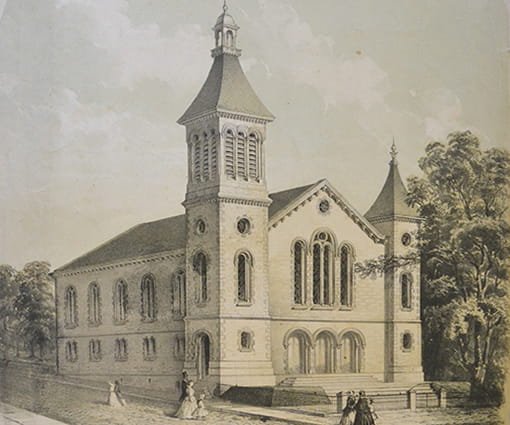
1695 The First Congregational Church, now called Newport Congregational Church (NCC), gathers in Newport, Rhode Island.
1857 The current church structure at the corner of Spring and Pelham Streets is built under the direction of architect Joseph C. Wells (a founding member of the American Institute of Architects), with seating for 1000 congregants.
1880 John LaFarge is commissioned to create a comprehensive decorative scheme for the sanctuary.
2011 To facilitate restoration, the Congregation deeds the Sanctuary and Parish House to the La Farge Restoration Fund as a gift.
2012 Ex-Newport Congregational Church receives National Historic Landmark status
2013– Complete restoration of building begins
sources
The Art Amateur, “Talks with Decorators: John La Farge on the Re-Decoration of the American ‘Meeting House’”, June 1887—John La Farge muses on his work at Newport Congregational Church. His description of the sanctuary is used here.
Connors, Ned, “National Historic Landmark Nomination”, La Farge Restoration Fund, 2011—Architectural and Cultural Historian Ned Connors’ monograph is the La Farge Restoration Fund’s National Historic Landmark application. It is an excellent summary of La Farge’s life, his artistic accomplishments, and the history of the church and its congregations. Interestingly, because the case statement had to be made for NHL designation, Mr. Connors compares and contrasts La Farge’s other commissions in detail.
La Farge, John, “The American Art of Glass” Forum, July 1893—La Farge writes on his view on a new, American approach to glassmaking and his work in bringing it into being.
Waern, Cecilia, “John La Farge: Artist and Writer” Portfolio, MacMillan and Co., New York, 1896—A good primary source as the writer uses extensive remarks by La Farge on his experiences, tastes, techniques, and ideas about art.
Weinberg, Barbara, “The Decorative Work of John La Farge”, Garland Publishing, New York, 1977—Dr. Weinberg, retired curator at the Metropolitan Museum of Art, is expert in the field of 19th Century American Decorative Art. Her article is an outstanding survey of La Farge’s glass working techniques and finished glass works.
Yarnell, James L., John La Farge: A Biographical and Critical Study, Ashgate Publishing Company, Burlington, VT, 2012—Professor Yarnell’s biography is the source of most of the details of La Farge’s life. The author is a professor at Salve Regina University in Newport, RI.